Eric Lacsamana, NDFP International Representative
November 29, 2024
It is with profound honor and great responsibility that I welcome you to this timely and critical gathering—a conference dedicated to understanding and advancing the cause of national liberation from imperialism. In these turbulent times, when the contradictions of US imperialism and the resistance against imperialist domination intensifies, our discussions today hold immense importance.
We are witnessing a world gripped by chronic crises. The unending thirst of imperialist powers for profit and hegemony coupled with the worsening crisis of late-stage capitalism, has wreaked havoc across the Global South and beyond through imperialist wars of aggression in their attempts to redivide the world. We examined these themes during the first and second NDFP international theoretical conferences: on imperialist wars in October of 2023, and on economic crises of imperialism in March this year.
These conferences including today’s conference on the topic of national liberation from imperialism are deeply interconnected as they address the core dynamics and contradictions of the imperialist system. Imperialist wars are the violent expression of competition among major powers and their attempts to secure resources, markets, and labor across the globe. These wars are both a symptom and a cause of the economic crises intrinsic to capitalism, which constantly disrupt global economies through the crisis of overproduction, rampant financial speculation and uneven development. The exploitation and plunder perpetuated by these crises disproportionately impact countries in the Global South, intensifying their subjugation and fueling resistance.
As a result, national liberation movements emerge both as a response to the economic, political and military oppression wrought by imperialism and as a revolutionary pathway to break free from its chains. Together, these conferences form a comprehensive analysis of imperialism, showing that war, economic crises, and the emergence of national liberation struggles are not isolated phenomena but integral aspects of our common struggle against imperialist domination. We examine these dialectics today equipped with higher levels of understanding we have achieved from previous theoretical conferences hosted by the NDFP.
Addressing the national question in different contexts of struggle
Today, we give particular importance to national liberation movements led by proletarian parties and struggles that employ armed means as they are at the vanguard of resistance against imperialism, particularly in regions where imperialist exploitation and occupation are most severe. These movements, rooted in the Marxist-Leninist principle of self-determination, seek not only to achieve political independence but also to fundamentally transform the social structures that sustain imperialist domination. These liberation movements struggle for national independence with a socialist perspective and often draw from the strategy of the two-stage revolution, a framework developed and enriched by the revolutionary theories of Lenin, Stalin and Mao. This approach emphasizes the necessity of addressing the democratic tasks of national liberation and anti-imperialism as a precursor to the socialist transformation of society, particularly in semifedual and/or semicolonial conditions. Lenin viewed national liberation as an essential component of the broader proletarian revolution, especially in colonies and semi-colonies oppressed by imperialism. Stalin further developed Lenin’s ideas on the national question, emphasizing the centrality of the proletarian party in leading the revolutionary process. In his work on the Foundations of Leninism, Stalin highlighted the importance of national liberation movements in the global struggle against imperialism, particularly in the era of monopoly capitalism. Mao Zedong adapted the two-stage revolution to the specific conditions of China, a semi-feudal, semi-colonial country dominated by imperialist powers. Mao argued that the first stage required a New Democratic Revolution led by the proletarian party, in alliance with the peasantry, petty bourgeoisie, and even sections of the national bourgeoisie willing to resist imperialism and feudalism.
On the other hand, certain nation-states have sought to assert their independence through policies and political stances that defy US hegemony and neoliberal orthodoxy. This resistance often takes the form of state-led initiatives to reclaim sovereignty over natural resources, build regional alliances, and pursue alternatives to the “Washington Consensus.” Bolivarian states such as those led by Venezuela under Hugo Chavez and Nicolas Maduro – have championed an anti-imperialist agenda but were met with destabilization attempts and crippling economic sanctions. Nations like Zimbabwe, which pursued land reform policies, have faced severe economic retaliation for asserting their sovereignty. In West Asia, countries like Iran resist US imperialism while grappling with their own international contradictions and navigating regional dynamics. Many states in Central and South Asia such as Pakistan, Nepal, and Sri Lanka, navigate a precarious balance between asserting independence and being drawn into the geopolitical rivalry between the US and China. These struggles underscore the importance of building self-reliance and strong anti-imperialist alliances, while also highlighting the necessity of proletarian leadership to ensure these struggles go beyond bourgeois nationalism and toward socialism.
In advanced capitalist countries, the national question and the right to self-determination remain highly relevant topics of discussion because imperialism, far from eliminating national oppression, perpetuates it both externally and internally. In these contexts, proletarian parties address the national question by uniting the working class, building unities with other oppressed classes and progressive and positive forces, and challenging their own states’ imperialist policies while supporting national liberation movements abroad. The continuing relevance of the national question in advanced capitalist countries reminds us that imperialism’s contradictions both at home and abroad, linking the struggles of oppressed nations with the broader struggle for socialism.
Exploring these three themes: national liberation movements with proletarian leadership, the struggles of nation-states assertive of their independence, and the continuing relevance of the national question in advanced capitalist countries-illuminate the multifaceted implications of asserting independence from imperialism, including the economic, political and military challenges that arise, and the revolutionary pathways needed to overcome them.
The implications of asserting independence from imperialism
While the assertion of independence is a necessary step toward liberation, it is met with brutal retaliation by imperialist powers. The mechanisms of control—military, political, and economic—are swiftly deployed to undermine any attempt at liberation.
The direct military occupation of nations, as we see in the case of Palestine, serves as a grim reminder of the lengths to which US imperialism will go to crush resistance. The settler-colonial project of Zionist Israel, backed by the US, has subjected the Palestinian people to generations of displacement, apartheid, and violence. Such occupations aim not only to seize territory but to break the will of the people and their struggle for liberation.
Politically, imperialism uses political coups, covert operations, and other forms of destabilization schemes to suppress governments that challenge its dominance. In Latin America, we have witnessed numerous coups—some overt, others thinly veiled as democratic interventions—against anti-imperialist governments. The ousting of Evo Morales in Bolivia in 2019 and the repeated attempts to destabilize governments in Venezuela and Nicaragua exemplify this strategy. These coups are often carried out under the guise of combating corruption or restoring democracy but are, in reality, tools to maintain imperialist control.
Economically, the use of sanctions has become a preferred weapon of US imperialism. Countries like Venezuela and Cuba face crippling embargoes that isolate them from global trade, undermine their economies, and impose immense suffering on their populations. For over six decades, Cuba has been subjected to a US-led economic blockade that barred the country from conducting direct trade with US-controlled companies and prohibited them from importing goods containing US-origin components, even from third countries. Financial assets abroad are frozen, limiting the country’s ability to invest more in infrastructure, healthcare, and education while restrictions on importing advanced technology hinder Cuba’s development across industires. These sanctions have inflicted immense economic damage as embargoed countries struggle to access essential goods, food, medicine and fuel. The US also sanctioned Venezuela’s state oil company, PDVSA which accounts for over 90% of the country’s export revenues. Restrictions on oil exports have effectively paralyzed their economy. These sanctions have further led to hyperinflation, and widespread shortages on goods.
The US also wields an arsenal of economic tools to exert control over nations, especially in the Global South, under the banner of the “Washington Consensus”—a term that encapsulates neoliberal policies propagated by institutions like the International Monetary Fund (IMF), the World Bank, and the World Trade Organization (WTO). These tools are designed and deployed by the US to dismantle national industries, privatize public assets, and deepen the dependency of their colonies and semicolonies. Through the IMF and World Bank, the US has imposed structural adjustment programs (SAPs) on highly indebted nations. These programs, implemented as conditions for loans or debt restructuring, demand drastic neoliberal reforms to allow foreign corporations, often US-based, to acquire critical infrastructure and industries at bargain prices. These same tools are responsible for imposing austerity measures, including cuts to social services like education, healthcare and subsidies, deepening inequality and poverty even further. It is responsible for deregulating and liberalizing markets to expose local economies to the domination of transnational corporations and the whims of financial capital. Debt dependency, engineered through high interest loans, ensures perpetual subordination. Nations spend vast portions of their budgets servicing debt instead of investing in domestic development. This debt trap becomes a mechanism for U.S.-led institutions to dictate national policies, effectively turning debtor nations into economic colonies.
To overcome these challenges, international solidarity among oppressed nations and peoples is paramount. The successes of movements that have resisted economic sanctions and coups, those who continue to valiantly resist direct military occupation, those who engage in armed revolutions in semicolonial and semifeudal conditions, and those situated in advanced capitalist countries—teach us the power of building self-reliance, collective action, and the unwavering commitment to socialist principles.
The challenge to national liberation movements
If national liberation is to be achieved and sustained towards socialism, the leadership of the proletariat becomes indispensable. The working class, as the most advanced class is capable of leading the struggle for independence through a two-stage revolution. This perspective, articulated by Marx, Lenin, Mao, and Stalin, remains crucial to our continuing analysis and practice.
In semi-colonial, semi-feudal societies, the path to socialism begins with a democratic revolution. This first stage involves the overthrow of imperialism, feudalism, and bureaucrat capitalism, establishing a government that represents the broad masses of the people. What immediately follows is the stage of socialist construction that aims to dismantle capitalist relations of production.
While the specifics of the two-stage evolution vary depending on the unique conditions of each country, the general principle follows the Marxist-Leninist understanding that oppressed nations and classes must first overthrow the remnants of feudalism and imperialism before moving towards the socialist transformation of society. We draw inspiration from Lenin’s insistence on the vanguard role of the proletariat, Mao’s strategy of protracted people’s war, and Stalin’s emphasis on the alliance of workers and peasants. These lessons remind us that revolution is a scientific process, requiring careful analysis, organization, and strategy.
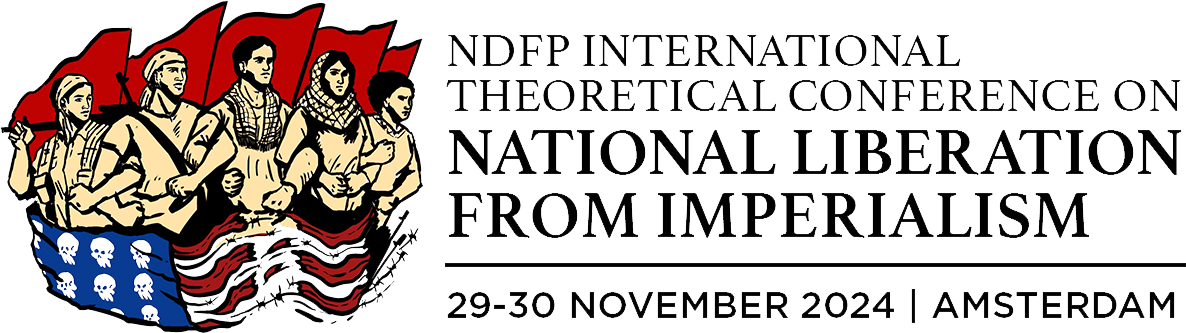
It is in this context that we invite proletarian and socialist parties, anti-imperialist nation states, organizations and national liberation movements to engage in this two-day conference. The topics we will explore are not merely theoretical but are deeply tied to the struggles and aspirations of billions of the oppressed around the world fighting for national and social liberation from the oppressive claws of imperialism. Let us use this gathering to deepen our understanding of imperialism and its mechanisms, to forge stronger ties of solidarity among our movements, and to advance the cause of national liberation.
Thank you.